Amounts belong to experiments
Sermorelin dosage has a clock attached
A stimulation test, a growth study and an aging experiment used the same peptide to ask different questions. Their amounts make sense inside those experiments.
Two clocks start together
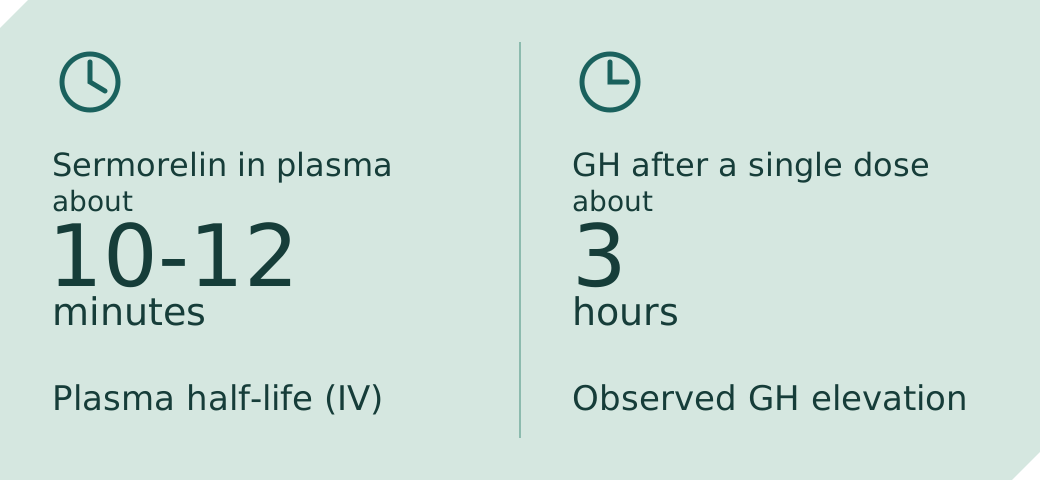
The most useful timing distinction is between sermorelin in plasma and the growth hormone released after it. Wilton and colleagues studied intravenous and intranasal GHRH(1-29)-NH2 in 30 healthy men. The peptide cleared rapidly while GH remained elevated for about 3 hours.
Sermorelin half-life
After intravenous administration, the plasma half-life is about 10-12 minutes: the time for the concentration to fall by half. That describes the peptide’s disappearance, while the roughly 3-hour finding describes the observed GH elevation. The pharmacokinetic study reports the brief exposure and longer hormonal response.
I think the two clocks explain more than the vague phrase ‘short acting.’ Neither clock measures a duration of better sleep, greater strength or reduced body fat. Nor does either one establish a safe interval for personal use.
The amount ledger
These are study doses and schedules, reported as parts of published experiments. They are not recommendations for human use. I regard the route and population as part of each entry’s identity; removing them makes the number misleading.
Prepubertal children with GH deficiency. The pediatric growth study used 30 mcg/kg/day subcutaneously at bedtime. Its outcome was first-year height velocity. The children’s condition and growth outcome are essential context.
Healthy older men. Corpas and colleagues gave 0.5 mg and 1 mg subcutaneously twice daily for 14 days. GH and IGF-1 rose in a dose-related manner. The higher studied dose brought the hormone measures into the range of the young comparison group, without changing fasting glucose.
Healthy men in a pharmacokinetic experiment. Intravenous doses of 0.25-2 mcg/kg were studied. GH release was significant at 0.25 mcg/kg and maximal at 1-2 mcg/kg. The investigators were examining exposure and secretion, not choosing an adult wellness regimen.
Diagnostic testing in children. A single 1 microgram/kg intravenous GRF(1-29)NH2 stimulus helped distinguish responses in GH-deficient and normal-stature children. The experiment concerned localization of a deficiency. A test dose has that particular purpose.
Changing the entrance changes the experiment
Intranasal bioavailability was only 3-5% in the GHRH(1-29) pharmacokinetic study. A separate experiment used the modified analog [Nle27]GHRH(1-29)-NH2; compared with intravenous delivery, it required a tenfold higher subcutaneous amount and a thirtyfold higher intranasal amount for the hormonal response. That route comparison concerned a modified peptide.
My skepticism about convenient alternate formulations starts there. The exact nasal finding cannot be assigned to a tablet or a troche, and a different formulation still needs its own exposure and outcome evidence. The experiment gives no conversion rule for personal use.
Bedtime was an experimental choice
Nightly GHRH(1-29) was studied in healthy elderly men for effects on the GH/IGF-1 axis. That choice fits the nocturnal GH question. It does not establish one best time for an individual, and it does not make sermorelin a proven sleep treatment.
Nor do the studies settle whether ‘3 months is enough.’ The older-men experiment lasted 14 days; the pediatric growth trial judged the first year; the tesamorelin cognition trial ran 20 weeks. Different outcomes take different experiments.